

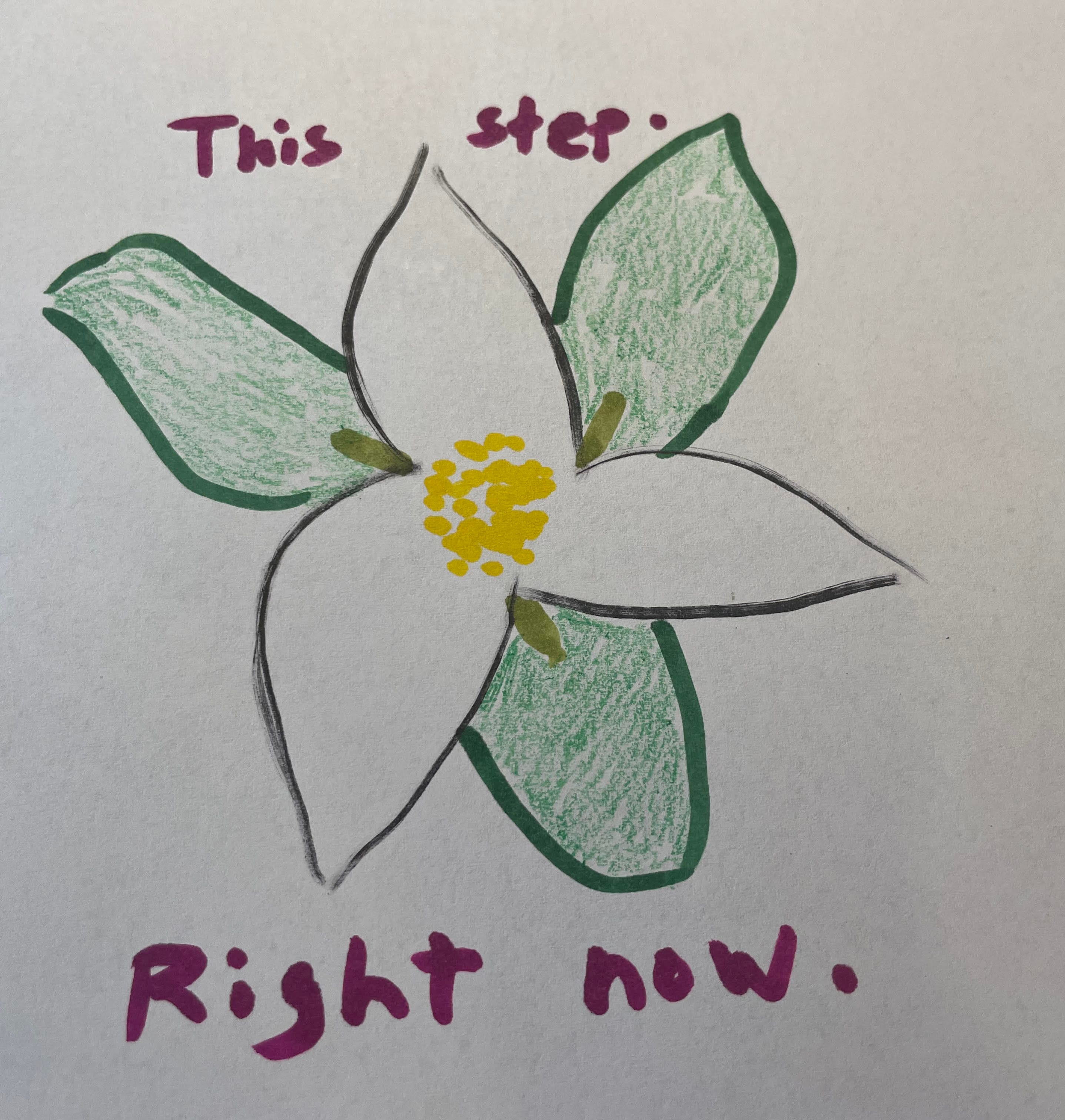
This past month, I learned how to draw a trillium bloom. I followed the directions in Pacific Northwest Line Drawingand have been practicing it over and over. It never quite looks the same, often coming out lopsided. But I don’t care. This month I hope to add the Olympic Marmot and the marionberry to my repertoire. This book sat on my shelf for a few years before I finally cracked it open and tried a drawing. It’s supposed to be a simple, step-by-step guide to making illustrations of things from the Pacific Northwest. I bought it because it was full of things I’ve seen on walks and hikes over the years and because it pressed on this longing I’ve had to draw, a longing I’ve often pushed down with a story about how I’m just not any good at drawing. When I interrogate this story, I know better, but our brains are full of all kinds of limiting beliefs like that one. I know from other practices I’ve taken up over the years that skillfulness isn’t something you have or don’t have. It comes through practice.
If I wanted to get good at drawing, could I? Sure, if I was willing to put in the work. I’m not. I’m content to add a few doodles to my set. This month I’m thinking a lot about leaning fully into the practices I’ve chosen, prioritizing the time spent at my writing desk, on my yoga mat. Sure, I might doodle in the margins, practice a little guitar, but those things are tiny meditations that make space for presence when I’m doing the work of my heart.
Thursday night, we went to hear Ann Patchett speak at Benaroya Hall in Seattle. The house was packed! I suppose I knew Patchett had become something of a literary celebrity, but there’s nothing like seeing a concert hall full of fawning fans (mostly women) to put the level of fame into right perspective. There were several nuggets of wisdom I gleaned in her conversation with Claire Dederer that relate to the theme of this post. She talked about the importance of writing because you love to write, without expectations about the outcome. The metaphor she used is that you are a pipe full of gunk and you just have to push water through and through and through, with water being words on the page. She talked about her failed book before her most recent novel Whistler, and how she took things from the rubble of that failed book into her new book, which did not fail. It is the most recommended book this summer, and I can see why. It’s light, but not light. It’s full of compelling characters with complicated relationships, and it meditates on impermanence without bumming the reader out.
Speaking of impermanence, the revered Natalie Goldberg connects the practice of writing to this Buddhist concept in her classic Writing Down the Bones, which is, in my opinion, the only book on practice a writer really needs. This book was gifted to me by my aunt. I was sixteen, aching to write and absolutely clueless as to how to begin. Goldberg encourages us to begin without purpose or judgement. Her freewriting method is a wonderful way to discover what it is you are meant to be writing or to collect seeds for future projects. In Writing Down the Bones (1986), she presents six rules for freewriting, but then in Wild Mind(1990), she adds a seventh.
- Keep your hand moving.
- Lose control.
- Be specific. Describe rather than explain whenever you can.
- Don’t think.
- Don’t worry about grammar, spelling, or punctuation.
- You are free to write the worst junk in the world.
- Go for the jugular. Meaning, lean in to what is painful or difficult to write.
Which one was added in 1990? You are free to write the worst junk in the world. While she had been clear in WDTB that the purpose of this method was to write without judgement and without stopping to escape the inner critic, she decided to emphasize it by putting it in the rules. I get that. Our inner critic/skeptic is our biggest, most insidious impediment in writing.
The title of this month’s newsletter comes from Diane Wakoski’s “I Played My Way Through”, a poem about how creative practice strengthens our resilience. Practice for me has always been twofold: a way to improve my skill and a means of processing pain. The novella that I self-published in 2016 explores the subject of how practice can quite literally save us, make us better over time in more depth. I won’t link it here, since next month we’re releasing a tenth-anniversary edition, and I plan to link it then.
This month, the exercise and the reflection questions are all meant to urge you to lean into the practice of writing or whatever creative work you are taking up and make whatever little refinements you might be ready to make.
Small Things That Have Been Bringing Me Joy
- The first sip of ayurvedic ‘gatorade’ just before I start to write every morning Thanks to my teacher Lisa Ostler for this and so much more
- Yoga on the porch! Imagine a view of the garden and wind chimes
- Going for walks and paying attention to which flowers are blooming now and what cool things people are doing with their gardens
- Seeing how long I can go through the day without checking my phone
- My summer writing routine, and all the little details that make it feel like a ritual
- The mantra I’ve been working with: “This step. Right now.” These words remind me to get back to the moment I’m in when I am wheeling off into the future when school starts, or our old dog who yesterday had 18 lumps on her body scanned for cancer risk is no more, or whatever else my mind has latched on to that take me out of the moment, the moment being where awe resides
- Standing in sunbeams
Found Sentences from What I’ve Been Reading
“You are never not your longing.” –Ani Gjika, An Unruled Body
A Writing Prompt for July
Using Goldberg’s 7 rules, do at least three timed writing sessions (10 to 30 minutes each). Choose one of the following prompts or pick your own. Email me about how it went. Maybe even share a little from what you wrote. I promise to write back.
Summer
Yesterday
Blue
Highway
Root
Voice
Practice
July/August Goals
I’m keeping my goals for June/July, and adding two:
- Aim for 70/30 in honor of many tai chi moves in terms of success in showing up to write every day (weekends included) from 6-10 am and then again from 2-5.
- Finish a chapbook of poems and start sending poems out
- Three queries every day
- Timed writing on Rose novel
- Lean into the ritual without shame. Palm a crystal. Pull a divination card. Light a candle. Breathe.
Reflection Question for Your Creative Practice
What does your creative practice look like now, and how could you make it work better for you? Perhaps this means leaning into the magic of ritual. Perhaps this means getting flexible about time or location. Perhaps it means finding a community to practice with.
I also work as a writing coach and love helping writers gain confidence, set goals, and develop their work. I was a writer first, but I’ve been teaching for over twenty-five years. Coaching weaves those two skill sets in a way that I love, love, love. I work with writers locally and over Zoom. For more information on coaching, email me at eatyourwords.lizshine@gmail.com or see my website.
You can see my books here and read some of my short works here.
Looking for any of the books I’ve mentioned here? Order through my Bookshop.org affiliate page to support me and my local bookstore!